

The Keeper Report Card: Hindsight Is Undefeated
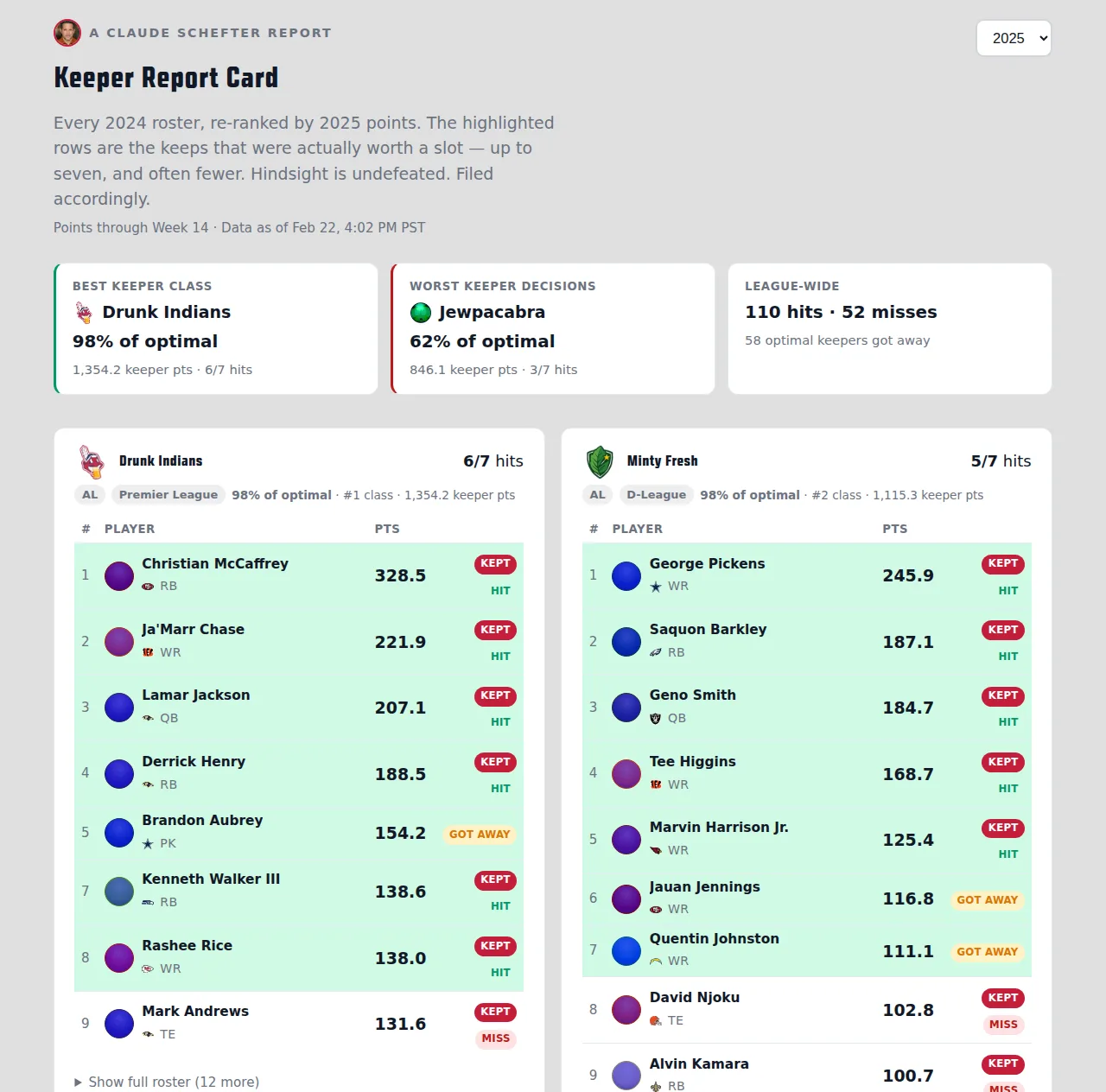
A new Claude Schefter report grades every AFL keeper class by the only judge that matters — what actually happened. Your 2024 roster re-ranked by 2025 points, the seven you should have kept highlighted, and every hit, miss, and the-one-that-got-away called out by name. A keeper is worth the points he scored in the games you could have started him — backups count a fraction — so the grade is about the call you made, not the roster you inherited. Flip to 2026 to see this year's classes waiting for kickoff.
The Full Story
You had all offseason. You studied the roster, you agonized over the seventh spot, you declared your keepers with the quiet confidence of a person who has definitely not just protected a running back about to lose his job in training camp. And then the season happened. The Keeper Report Card is where those two stories meet: every franchise's previous-season roster, re-ranked by what those players scored the following year, with the hindsight-optimal seven highlighted in green.
Every keep gets a verdict. Keep a top-seven scorer? Hit. Keep someone who finished ninth on your own roster? Miss. Let a top-seven scorer walk back into the draft pool? That's the one that got away, and yes, it's labeled in yellow so everyone can see it. The league summary up top crowns the best keeper class, names the worst keeper decisions, and tallies the misses league-wide.
Here is the part that decides the table, and it's mercifully simple: a player is worth the points he scored in the games you could actually have started him. The optimal seven have to fit a real lineup — one QB, one kicker, one defense, and six from RB/WR/TE — because a third quarterback with nowhere to play isn't a keeper, he's a paperweight with a clipboard.
Every class is then scored on the share of its own ceiling it captured: the value your keepers delivered, divided by the value of the seven you could have kept. That grades the call instead of the collection — the ceiling swings roughly 2x from the league's thinnest roster to its deepest, and nobody chose the roster they inherited. Max out a thin roster and you'll beat a rival who left points on a loaded one.
Backups aren't written off — they're credited the share of their points they'd realistically have played. A seventh skill player rotates in across six flex starters' byes and matchups, so he counts 7/10 of his points. A second quarterback, kicker, or defense only plays the starter's bye week and the odd matchup call, so he counts 1/10. Both are “backups” and they are nowhere near equally valuable — bench keeps are marked Bench and priced accordingly.
Kickers and defenses aren't excluded from anything. Your starting kicker's points are real points at a real lineup slot, and passing on a big-leg season can be a genuine miss. A second kicker, though, counts a tenth of his points — which is the polite way of saying stop stockpiling kickers.
The bottom of the page spells out the whole rubric, because a report card that doesn't tell you how it grades is just a number with an attitude. The page defaults to the last finished season while we wait on kickoff. Once the 2026 games start, the grades go live and update all year — check back weekly to watch your genius (or your shame) accumulate in real time.
Message